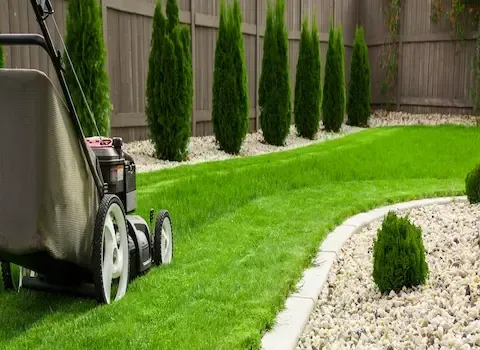
Tall Fescue Mowing Heights in Sioux City Iowa Yards
Tall fescue is one of the most forgiving cool-season grasses you can grow in a Sioux City yard, but only when you mow it at the right height. Set the blade too low and you scalp the crown, invite weeds, and push the grass toward heat stress during Woodbury County summers. Set it too high in early spring and you slow green-up and create thatch problems. Getting the height right across the full calendar year is one of the simplest, highest-impact decisions any Sioux City homeowner can make for a healthy lawn.
Why Mowing Height Matters More for Tall Fescue Than Other Grasses
Tall fescue is a bunch-type grass, meaning it does not spread by stolons or rhizomes the way Kentucky bluegrass does. Each plant grows in a tight clump and relies almost entirely on its leaf blade surface area to photosynthesize and feed the root system. When you remove too much of that leaf blade at once, the plant cannot recover quickly. It draws down carbohydrate reserves stored in the crown and roots, leaving the lawn thin and vulnerable.
In Sioux City's USDA Zone 5a climate, tall fescue faces real stress in July and August when temperatures routinely climb above 90°F and humidity can spike overnight. Taller blades shade the soil directly beneath the plant, keeping root-zone temperatures lower and reducing moisture loss. Research from university extension programs consistently confirms that tall fescue maintained at higher mowing heights retains more soil moisture between rain events than the same variety mowed short.
The Standard Height Range for Tall Fescue in Sioux City
For most residential yards in Sioux City, the ideal mowing height for tall fescue falls between 3.5 and 4.5 inches during active growing periods. The sweet spot for general maintenance through spring and early fall is 3.5 to 4 inches. During peak summer heat, raise the deck to 4 to 4.5 inches. This range applies whether your lawn is in a newer development near the Highway 20 corridor or an older established neighborhood closer to downtown.
Never cut below 3 inches at any time of year. Cutting shorter than 3 inches on tall fescue accelerates surface thatch accumulation, weakens individual plants, and opens the canopy wide enough for crabgrass and annual broadleaf weeds to establish. Once those weeds get a foothold in a Sioux City lawn, they are considerably harder to remove than preventing their entry in the first place.
Seasonal Mowing Height Adjustments by Month
Tall fescue does not need the same height setting in April that it needs in August. Walking through the calendar with a plan helps you stay ahead of the grass rather than reacting to problems after they start.
- March and Early April: If you did not take the deck down slightly before winter dormancy, mow once at 3 to 3.5 inches on the first cut to remove dead tips and stimulate new growth. Do not fertilize yet.
- Mid-April through May: Primary growing season begins. Maintain 3.5 to 4 inches. Mow every 5 to 7 days as needed using the one-third rule. This is peak green-up in Sioux City, typically coinciding with temperatures consistently above 50°F.
- June: Begin raising the deck incrementally as daytime temperatures push toward 80°F. Target 4 inches through June.
- July and August: Maximum height season. Keep the deck at 4 to 4.5 inches. Mowing frequency slows naturally as growth slows in heat stress. Avoid mowing dormant or drought-stressed grass when possible.
- September and Early October: Cool season returns and tall fescue rebounds aggressively. This is the best overseeding and fertilization window in Sioux City. Drop back to 3.5 to 4 inches as temperatures moderate.
- Late October and November: Lower the deck gradually as growth slows. Take the lawn down to 3 to 3.5 inches for the final mow before dormancy. This reduces the risk of snow mold and matting under heavy Sioux City winter snowfall.
The One-Third Rule and Why Sioux City Homeowners Skip It
The one-third rule is simple: never remove more than one-third of the blade in a single mowing pass. If you maintain tall fescue at 4 inches, you should mow before it reaches 6 inches. Most homeowners understand this in principle but abandon it during busy weeks in May and June when the grass is growing fastest.
Skipping a mowing cycle and then cutting down to height in one pass is one of the most common lawn care mistakes in residential yards throughout Woodbury County. The resulting stress is visible within 48 hours as a yellow or brown cast across the lawn. If you miss a week, raise the deck for that session, then step back down to your target height on the next mow a few days later rather than shock-cutting.
For consistent results without the guesswork, Lawn Mowing services handled by a professional crew remove the variable of skipped cycles entirely. A scheduled service maintains proper interval discipline through every growth stage.
Drought Adjustments Specific to Sioux City Summers
Sioux City does not irrigate uniformly. Many neighborhoods near the Missouri River corridor have properties on municipal water with in-ground systems. Yards farther from the river in the western hills often rely entirely on rainfall. Your mowing height strategy should reflect your irrigation reality.
If your Sioux City yard has no irrigation system and rainfall falls below one inch per week through July, leave the deck at the top of its range, 4.5 inches, and stop mowing altogether if the grass stops growing. Tall fescue enters a semi-dormant state in extended drought. Mowing dormant grass removes the leaf tissue it is using to protect the crown. When rain returns, growth resumes and you can drop back to your normal height within two mow cycles.
If you do irrigate, maintain consistent height at 4 inches through the summer and water deeply twice per week rather than shallowly every day. Deep, infrequent watering encourages root depth, which directly supports the taller mowing height by giving roots access to subsurface moisture during the days between watering sessions.
Blade Sharpness and Its Effect on Tall Fescue in Zone 5a
Mowing height is only half of the equation. A dull blade tears grass tissue rather than cutting it cleanly, leaving ragged tips that brown within a day or two after mowing. On tall fescue, which has a coarser leaf structure than bluegrass or ryegrass, dull blades cause visible tip browning even when height is set perfectly.
Sharpen mower blades at least twice per season in Sioux City: once before the first spring mow in April and again before the September growth surge. If you mow a typical 6,000 to 8,000 square foot residential lot, that interval is usually sufficient. Larger properties or those with sandy soil that accelerates blade wear may need sharpening three times per season.
Mowing Height in Context of Tall Fescue Lawn Care
Mowing height does not work in isolation. It pairs with your fertilization schedule, overseeding timing, and weed control applications. Understanding how these practices interact throughout the year helps you avoid common conflicts, such as applying a pre-emergent herbicide at the wrong time relative to overseeding, or fertilizing in summer heat at the wrong nitrogen rate for the blade length you are maintaining.
If you are building out a complete care plan, reviewing Lawn Mowing Practices for Homeowners gives you the broader framework into which seasonal height adjustments fit naturally.
Tall fescue rewards consistency. A Sioux City yard managed at the right height through every season, with sharp blades and appropriate mowing intervals, will outperform the same variety that is mowed reactively. The grass does not need perfection, but it does need a plan that accounts for Zone 5a weather patterns, summer drought risk, and the real growth calendar that comes with living in northwest Iowa.
